The battery gives Gerbera growers greater flexibility and lower energy costs

A payback period of under four years looks achievable
Klondike Gardens commissioned a battery to gain more control and flexibility over its energy management and the associated costs and revenues. Enova supports the company in managing its energy flows and works together with battery supplier BattiQ, which monitors the technical performance.
Klondike Gardens has two sites, growing gerbera as its main crop and cut calla as a second crop. At the 3-hectare site dedicated entirely to gerbera, installer Stolze fitted a battery with a storage capacity of 2.61 MWh and a power rating of 1,250 kW in May.
'Energy is both a major cost item and a promising source of income when you can feed power back to the grid at the right moments,' says Ruud van Leeuwen, who runs the family business together with his brother Tom. 'A battery gives us the flexibility to respond to that, in conjunction with the rest of the energy system and how it's deployed for the crop. We worked out the figures for this together with Enova, our regular installer Stolze, and battery supplier BattiQ.'
Responding better to market opportunities
At the 3-hectare site where the battery went into operation in May, a CHP (combined heat and power) unit generates heat and electricity. The site's own electricity demand is mainly determined by a dimmable LED lighting system and an electric boiler.
'With a well-sized battery, combined with the CHP unit, you can respond better to the aFRR market and make the most of the moments when feeding power back to the grid pays well, including during lighting hours. You can also charge a battery with purchased electricity at cheap times, when the CHP unit isn't needed for heat production and generating your own power would be more expensive.'
Energy is both a major cost item and a promising source of income when you can feed power back to the grid at the right moments.
One partner for strategy and execution
With Enova's energy management system (EMS), energy flows can be steered to achieve maximum returns within the boundaries of high-quality cultivation. Those boundaries are, and remain, the guiding principle, stresses Enova's energy manager.
'Together with my colleagues, I work to take as much of the energy burden off our customers' hands as possible and get the best possible return from their energy system,' he explains. 'The EMS system gives growers control over complex energy flows, grid congestion and real-time market prices. A battery isn't essential for that, but it can help achieve that goal.'

Technical performance
For Klondike Gardens' gerbera site, a battery of this kind proved to add more than enough value, says Jan Dijkshoorn of BattiQ. 'Our joint assessment resulted in a battery with a storage capacity of 2.61 MWh and a power rating of 1,250 kW. It runs at a voltage of 400 volts, matching the transformer already in place at the company.'
Dijkshoorn notes that his company also stays involved after a battery is delivered. 'Enova operates across multiple energy markets and steers a customer's energy system as a whole to achieve the highest possible financial return,' he continues. 'That's the commercial side of the story. Our role is to monitor the battery's technical performance, so that it can fulfil its role at any moment. The battery at Klondike consists of ten units, each containing around 1,000 Modbus components for monitoring. Our smart software reads these out every second to track how the components are performing and working together. Among other things, this means keeping the internal temperature of the components, and of the battery as a whole, within the required bandwidth. Controlling a battery's technical performance calls for advanced software. In our case, that isn't an EMS, but an asset management system, or AMS.'
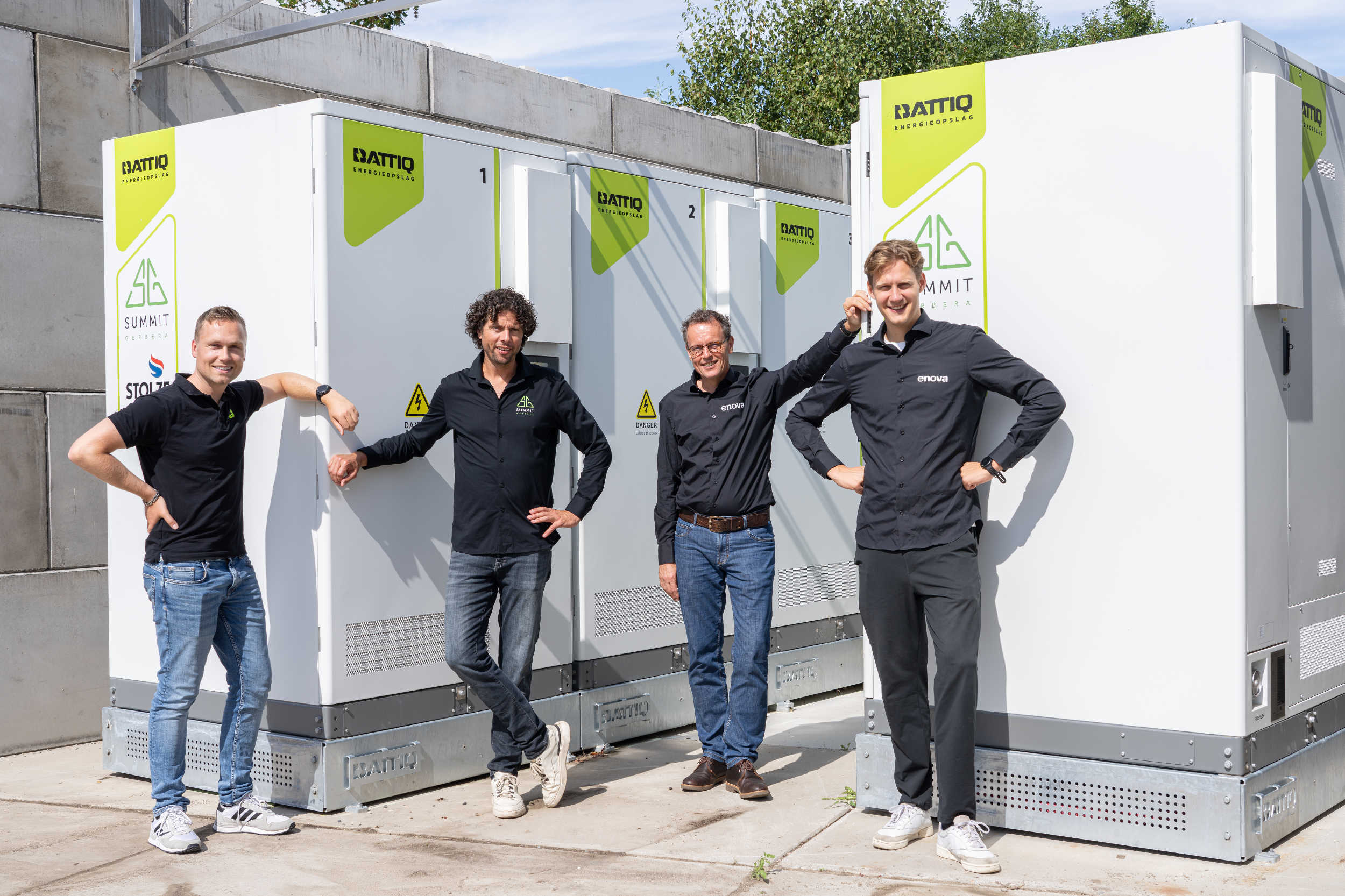
"A payback period of under four years looks achievable".
Uptime and downtime
The extent to which a battery is or isn't available for use is expressed in uptime and downtime. Dijkshoorn: 'Downtime occurs when a battery isn't functioning properly or is out of service for technical maintenance. At those moments, the battery isn't available as an asset for Enova to use in steering the energy flows. Our job is therefore to keep downtime to a minimum. We aim for an uptime of 98%, which is fairly ambitious. Right now, we're actually achieving 99.8%. Force majeure situations, such as a power cut that takes the electricity grid down temporarily, aren't included in that figure. Fortunately, those situations are rare.'
Collaboration pays off
Achieving a high return requires good collaboration between the client, Enova, the battery supplier and the installer involved. 'I keep an eye on that too, as energy manager, partly through regular reviews,' sums up Enova's energy manager. 'In my experience, that's how we can take the full burden off the customer, which is of course the whole point.'
Ruud van Leeuwen confirms that the collaboration has worked well so far. 'The battery is an asset to our system, and we're pleased with Enova's active role and the results it's bringing. Energy costs per square metre are now lower, we're getting more out of exporting power, and we have less to worry about. Based on that, we think we can pay back the battery within four years. That's faster than we initially expected. It remains to be seen how the energy markets develop, but we're confident that this investment, and the collaboration with all the parties involved, will pay off well and make our operation more flexible. That's what we set out to achieve.'
Ready to explore intelligent energy management?
Get no-obligation advice on the possibilities for your business. Get in touch with our specialists.
Interested in discussing the electrification of your logistics business?
Tell us who you are and we'll be in touch.